How to Follow Your Autistic Childs Lead During Play| DIR/Floortime
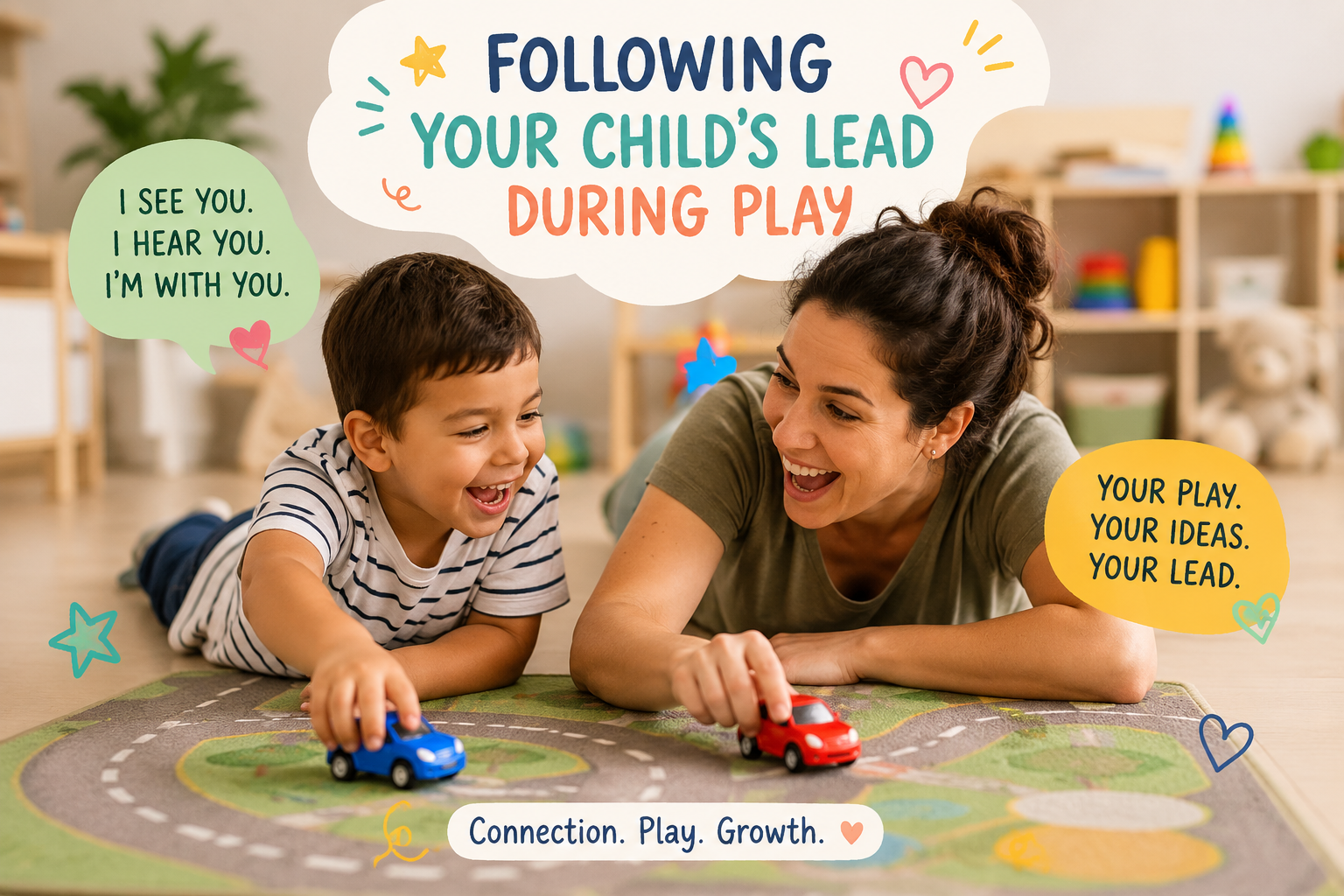
A smiling parent follows a young child's lead during play by copying their actions with toy cars on a play mat. Both are engaged in joyful, child-led play in a bright playroom, illustrating connection, shared attention, and relationship-based learning through DIR/Floortime.
One of the most powerful ways to support your child's development is surprisingly simple: follow their lead.
When children choose what interests them, they are more engaged, motivated, and ready to learn. By joining your child's play instead of directing it, you're showing them that their ideas matter and that you're excited to share their world.
Start by Watching
Before jumping into play, take a moment to observe.
What has your child's attention?
What are they doing with the toys?
How do they seem to be feeling?
Watching first helps you understand what your child is interested in so you can join in naturally.
Copy What Your Child Is Doing
One of the easiest ways to connect is by simply copying your child's actions.
If they're stacking blocks, stack your own. If they're rolling a car back and forth, roll another car beside them. If they're pretending to feed a stuffed animal, feed one too.
Imitating your child's play lets them know, "I see you. I'm interested in what you're doing." It often encourages more interaction, eye contact, shared smiles, and back-and-forth play.
Respect Their Ideas
Children don't always play with toys the "right" way—and that's okay!
A block can become a phone. A spoon can become an airplane. A cardboard box can become a race car.
Instead of correcting their ideas, follow along with their imagination. Creative play builds flexible thinking, problem-solving, and confidence.
Add, Don't Take Over
Once you've joined your child's play, look for small opportunities to expand it.
You might:
Add a new sound or funny action.
Introduce another toy that fits what they're already doing.
Pause and wait to see how your child responds.
The goal isn't to change the game—it's to build on what your child has already created.
Remember: Connection Comes First
Following your child's lead doesn't mean you never teach or guide them. It means that learning begins with connection.
When children feel understood, supported, and valued, they're more likely to communicate, explore, solve problems, and enjoy spending time with others.
The next time you sit down to play, try letting your child be the leader. You may be surprised by how much learning happens when you simply slow down, join in, and enjoy the moment together.
